The Ice Age and Origins of the Humber Watershed
Toronto, Ontario
Toronto, Ontario
Introduction
Overview of the
Humber River
Global and Continental Glaciation
Land Form Development in North America
Geological History
of the Great Lakes
Development of the
Oak Ridges Moraine
Geology of the
Humber River Watershed
Ecology & Recreation
Early Inhabitants
Maps of the
Humber River Watershed
Photo Gallery Humber River Watershed
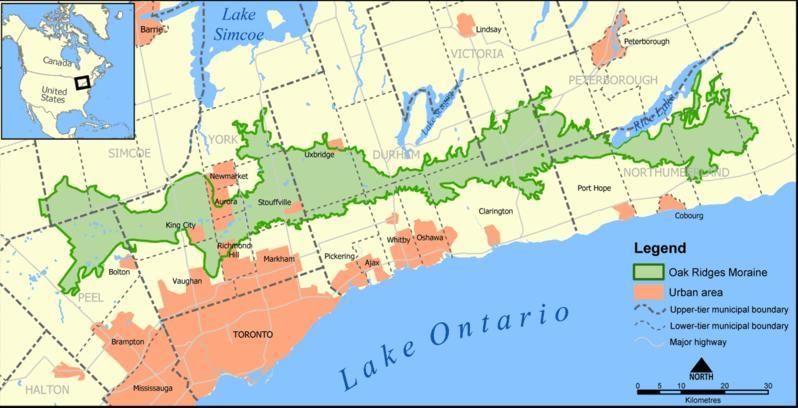
A Map of The Oak Ridges Terminal Moraine
Part I - Introduction
Moraines may be composed of debris ranging in size from silt-sized glacial flour to large boulders. The debris is typically sub-angular to rounded in shape.
Moraines may be on the glacier’s surface or deposited as piles or sheets of debris where the glacier has melted. Moraines may also occur when glacier- or iceberg-transported rocks fall into a body of water as the ice melts.
Terminal moraines, are ridges of debris deposited at the end of the glacier. They reflect the shape of the glacier's terminus. Glaciers act like a conveyor belt, carrying debris from the top of the glacier to the bottom where it deposits it in end moraines. End moraine size and shape is determined by whether the glacier is advancing, receding or at equilibrium. The longer the terminus of the glacier stays in one place the more debris will accumulate in the moraine.
There are two types of end moraines; terminal and recessional. Terminal moraines mark the maximum advance of the glacier. Recessional moraines are small ridges left as a glacier pauses during its retreat.
The Oak Ridges Moraine is the best example of a Terminal Moraine in Southern Ontario with huge benefits to the inhabitants.
Click for Part II => Genesis of the Oak Ridges Moraine
